Chicken paprikash: paprikás csirke and its story
Chicken paprikash, paprikás csirke in Hungarian, is chicken cooked with onion and paprika and finished with sour cream, usually served with small egg dumplings. In late October 2026 a portion cost about 4,900–7,000 Ft (about €13–19) on Budapest menus.
Below: the first written recipe from 1830 and why sour cream makes it a paprikás. Then the chicken supper in Dracula, Escoffier's version, and the two names for its dumplings.
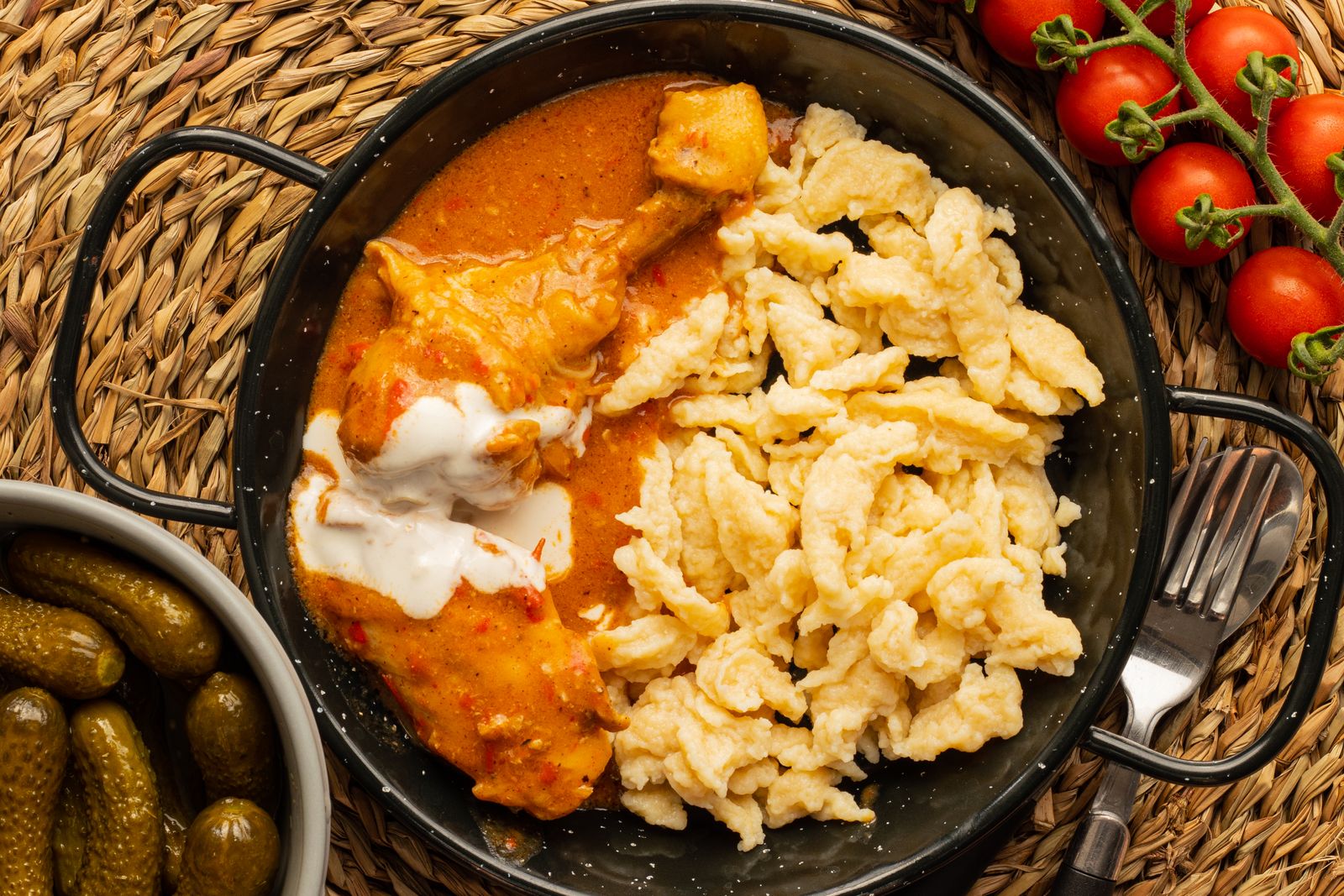
The first recipe, from 1830
The first known written recipe for chicken paprikash appeared in the 1830 edition of István Czifray's Hungarian National Cookbook. An 1888 edition calls Czifray the court cook of Palatine Joseph, the Habsburg governor of Hungary.
His recipe is short. Melt butter or lard in a copper pot, add paprika, allspice and onion, and stew until yellowish. Add the chicken and stew it until tender. Sprinkle with a spoonful of flour, pour in a little stock, and add sour cream to taste, so that the sauce is thick.
This was not the obvious menu of a noble household. Paprika was a cheap spice of the common people well before it reached the cookbooks of the gentry.
Sour cream makes it a paprikás
The main difference is one ingredient. Pörkölt is meat slowly cooked down with onion and paprika. Paprikás starts the same way and is finished with sour cream, which turns the sauce pale orange and rounder in flavour. Our guide to Hungarian dishes explains the pair, and our goulash article explains why gulyás is a soup.
The official list of hungarikums, Hungary's national treasures, has a surprise here. Chicken paprikash is not on it, but a mutton stew is: Karcag mutton pörkölt was added in 2013, from the town of Karcag on the Great Plain.
What is on the list is the paprika itself: ground paprika from Kalocsa since 2014 and from Szeged since 2015. Our paprika article tells the story of the two paprika towns.
Dracula's first dinner
Bram Stoker's Dracula, published in 1897, begins with a paprika chicken supper. In his journal entry of 3 May, Jonathan Harker recalls passing through "Buda-Pesth" by train. He stopped for the night at the Hotel Royale in Klausenburgh, today's Cluj-Napoca in Romania.
He writes in his journal that supper was "a chicken done up some way with red pepper". It was very good, but it made him thirsty. He reminds himself to get the recipe for his fiancée, Mina. The waiter calls it "paprika hendl", Hendl being the Austrian German word for chicken. As a national dish, he says, it can be had anywhere along the Carpathians.
His night was restless. A dog howled under his window all night, he writes, or it may have been the paprika. He had to drink all the water in his carafe and was still thirsty.
Paprika chicken in Escoffier's cookbook
The French chef Auguste Escoffier put a Hungarian chicken into his great cookbook. In the 1907 English edition, "Poulet sauté hongroise" is chicken sautéed in butter with onion and a little paprika, then cooked with tomatoes. The sauce is finished with cream rather than sour cream, and the chicken is served in a ring of rice pilaff.
Escoffier also recommends a paprika by name, that of "Messrs. Kotangi". The spelling looks like a misprint for Kotányi, a paprika firm that János Kotányi founded in Szeged in 1881.
How the dish got onto Escoffier's menus is a story rather than a documented fact. It is told in Hungary that Rezső Görög, a Hungarian cook who worked with Escoffier for years, talked him into trying poulet au paprika. In this story the actress Sarah Bernhardt came back from Budapest raving about the Hungarian food at a banquet given in her honour. The dish sold so well that it stayed on the menu.
Nokedli or galuska: one dumpling, two names
The dumplings served with chicken paprikash have two Hungarian names, and both are borrowed words. Nokedli [ˈnokɛdli] comes from the German Nockerl, "dumpling", a Bavarian word. Galuska [ˈɡɒluʃkɒ] comes from dialectal Polish galuszka, "ball".
Budapest menus use both. One restaurant serves "chicken paprikash with galuska", and the next writes "nokedli" for the same dumplings.
Some kitchens add something sour on the side, such as a cucumber salad. Our article on Hungarian pickles covers the rest of the sour side of the table.
The name itself is simple: paprikás [ˈpɒprikaːʃ] means "with paprika", and csirke [ˈt͡ʃirkɛ] is chicken. On menus you will see it as paprikás csirke or as csirkepaprikás.
What it costs and where to eat it
In late October 2026 chicken paprikash cost about 4,900–7,000 Ft on Budapest menus. Plates at the lower end do not include the dumplings, and most portions were between 5,300 and 6,000 Ft. Our price guide shows what else a meal costs in Budapest.
- Rokfort Hungarian Table Restaurant, District V: chicken paprikash for 4,890 Ft, with galuska as a side for 1,290 Ft.
- PAUSE Kitchen & Bar, District V: a tapas-size chicken paprikash for 3,390 Ft or a full portion for 5,990 Ft.
- Madhouse Bistro & Bar, District VI: chicken paprikash for 5,950 Ft.
- Incognito Kitchen & Bar, District VI: chicken paprikash with egg dumplings for 6,200 Ft.
- Market 1897 Kitchen & Wine, District IX: chicken paprikash with egg dumplings and cucumber salad for 6,900 Ft.
At DinePass partners the discount applies to à la carte food and drinks. The card's 10–30% discount applies to everyone dining with you.
Quick answers
What is chicken paprikash?
Chicken cooked with onion and paprika, finished with sour cream. In Hungary it is called paprikás csirke or csirkepaprikás, and it is usually served with small egg dumplings.
What is the difference between paprikash and pörkölt?
Sour cream. Both start as meat cooked with onion and paprika, but paprikash is finished with sour cream, so it is paler and rounder in flavour.
What are the dumplings called?
Nokedli or galuska. They are the same small egg dumplings, and both names are on Budapest menus.
Is chicken paprikash a hungarikum?
No. It is not on the official list, but the ground paprika of Kalocsa and Szeged is, and so is Karcag mutton pörkölt.
How much does chicken paprikash cost in Budapest?
In late October 2026 about 4,900–7,000 Ft (about €13–19) on Budapest menus.
The 1830 recipe from Wikipedia and Hungarian press; the 1888 edition of Czifray's cookbook from the Hungarian Electronic Library; the hungarikum entries from hungarikum.hu; the Dracula passage from the Project Gutenberg text; Escoffier's recipe from the 1907 English edition on Project Gutenberg; the Kotányi history from the company and the Hungarian Museum of Trade and Hospitality; the Escoffier story from Hungarian press; the word origins and pronunciation from Wiktionary; prices from live restaurant menus and the exchange rate from our pricing data. Checked on 29 October 2026.

Got a question? Ask a local
Bálint answers personally, usually within a day.
Your question is not stored on this site: it goes straight to WhatsApp or your e-mail app.
A word of Hungarian
Köszönöm
/ˈkøsønøm/
Was this page useful?