Jewish food in Budapest: flódni, sólet and the goose
Two dishes tell the story of Jewish food in Budapest. Flódni is a layered cake with four fillings: apple, walnut, poppy seed and plum jam. Sólet is a slow-cooked bean stew made for the Sabbath, which by the early 20th century had become part of Hungarian cooking at large.
Below: the Sabbath rule behind sólet, how a Jewish stew became a Hungarian one, the layers of flódni, the place of the goose, and where to start in Budapest.
Sólet: a stew that cooks while no one cooks
Sólet [ˈʃoːlɛt] is the Hungarian version of cholent, the Sabbath stew of the Ashkenazi Jews. Its reason to exist is a religious rule. Jewish law forbids lighting a fire on the Sabbath, yet in a cold climate people wanted a warm meal on Saturday.
The answer was a stew that is brought to the boil on Friday and left to cook slowly until the next day. A folk explanation even links the name to a Hebrew word for "that rested overnight", and recalls families who left their pots in the town baker's oven, which stayed hot.
The Hungarian sólet is made with beans and pearl barley, onion, garlic and goose fat. Smoked meat goes in, and eggs are cooked in the stew in their shells. It is often made with goose meat. Whether the beans should be white or speckled is a debate that never ends.
How a Jewish stew became a Hungarian dish
Sólet has a remarkable second life. A 2022 study traces how, by the end of the 19th century and the beginning of the 20th, the "Hungarian" sólet had become part of the majority cuisine.
In the same process it lost its link to the Sabbath in Hungarian popular food culture, even though it stayed central to traditional Jewish religious life.
Flódni: four fillings, five layers
Flódni is a traditional Hungarian Jewish pastry. Thin layers of pastry, usually five, alternate with four fillings: apple, walnut, poppy seed and plum jam. The top layer is brushed with egg yolk and baked golden. Many recipes add dry white wine to the dough, and some cook the poppy seed and walnut fillings with wine.
Its roots go back to older Ashkenazi pastries, but it is in Hungary that it took its present form, and Budapest is often described as its adopted home. It is traditionally eaten at Purim and Hanukkah.
Goose fat and kosher wine are said to have been among its original ingredients, later replaced by butter and ordinary wine. A popular reading says the separate layers stand for people of different faiths and origins living together; that is an interpretation, not a recipe.
The goose in Jewish cooking
The goose has a place in Hungarian Jewish cooking. Sólet is cooked with goose fat and often with goose meat, and flódni is said to have been made with goose fat at first.
Goose also sits on Budapest menus today. Some of our partners, which are not Jewish restaurants, serve cold goose liver with its own fat as a starter. Our article on St Martin's Day goose explains the bird's wider place in Hungarian food.
Where to start in Budapest
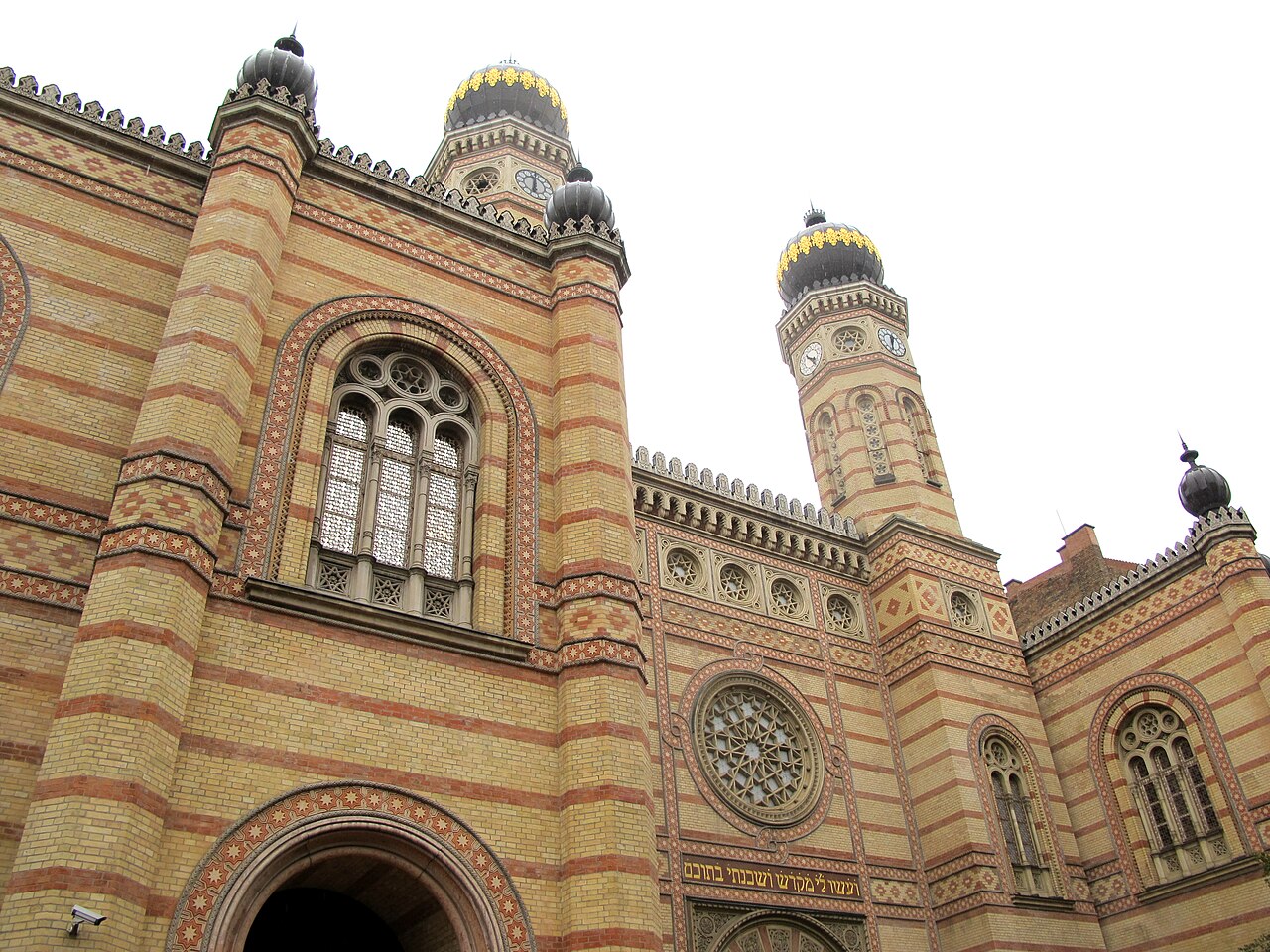
The landmark of Jewish Budapest is the Dohány Street Synagogue in District VII. It was built between 1854 and 1859 in the Moorish Revival style: the Vienna-based architect Ludwig Förster designed the exterior, and Frigyes Feszl the interior. Designed for 2,964 seats, it is the largest synagogue in Europe.
For the goose, these partners list cold goose liver in November 2026. Click a name to see the full menu with prices.
- Komédiás Kávéház, District VI: cold goose liver with its fat, vegetables and toasted kalács, a sweet braided bread.
- Király 100 Gastro Corner, District VI: cold goose liver.
At DinePass partners the discount applies to à la carte food and drinks. The card's 10–30% discount applies to everyone dining with you.
Quick answers
What is flódni?
A traditional Hungarian Jewish pastry of thin pastry layers with four fillings: apple, walnut, poppy seed and plum jam.
What is sólet?
The Hungarian version of cholent, a slow-cooked Sabbath stew of beans and barley with smoked meat, eggs cooked in their shells and often goose.
Why is sólet cooked overnight?
Jewish law forbids lighting a fire on the Sabbath, so the stew is brought to the boil on Friday and left to cook slowly until Saturday.
Is sólet a Jewish or a Hungarian dish?
Both. By the early 20th century the Hungarian sólet had become part of Hungarian cooking at large, according to a 2022 historical study.
What is the largest synagogue in Europe?
The Dohány Street Synagogue in Budapest, built between 1854 and 1859 and designed for 2,964 seats.
Sólet from Hungarian Wikipedia and a 2022 study in the Hungarian Academy of Sciences repository; cholent from Wikipedia; flódni from Wikipedia and Taste Hungary; the synagogue from Wikipedia; partner dishes from their live menus. Checked on 8 November 2026.

Got a question? Ask a local
Bálint answers personally, usually within a day.
Your question is not stored on this site: it goes straight to WhatsApp or your e-mail app.
A word of Hungarian
Számla
/ˈsaːmlɒ/
Was this page useful?