Kifli, kakaós csiga, túrós táska: a guide to the Hungarian bakery
A Hungarian bakery, a pékség [ˈpeːkʃeːɡ], sells three everyday classics: the crescent-shaped kifli, the cocoa swirl called kakaós csiga, and the cottage-cheese pastry túrós táska. In 2025 a plain white roll cost 71 Ft and a kakaós csiga 258 Ft on average across Hungary, according to the statistical office.
Below: the kifli and its link to the croissant, the snail and the bag behind the other two names, what the bakery counter costs, and how to order.
The kifli, older than the croissant
The kifli [ˈkifli] is a crescent-shaped roll made from a plain, bread-like yeast dough. The Hungarian word was borrowed from Bavarian-Austrian German, where the roll is a Kipfl or Kipferl.
The crescent roll is old. A medieval Viennese verse chronicle mentions it, set in 1227: bakers brought the Babenberg duke "chipfen".
A popular story says the crescent was invented to celebrate the defeat of the Ottomans at Vienna in 1683, its shape mocking the crescent on their flags. That is a legend, not a documented fact.
The kifli is generally agreed to be the model for the French croissant. In the late 1830s August Zang, an Austrian, opened a Viennese bakery on the rue de Richelieu in Paris that sold Viennese specialities, the crescent among them. The flaky, buttery croissant of today came later, when French bakers changed the dough.
A snail and a bag
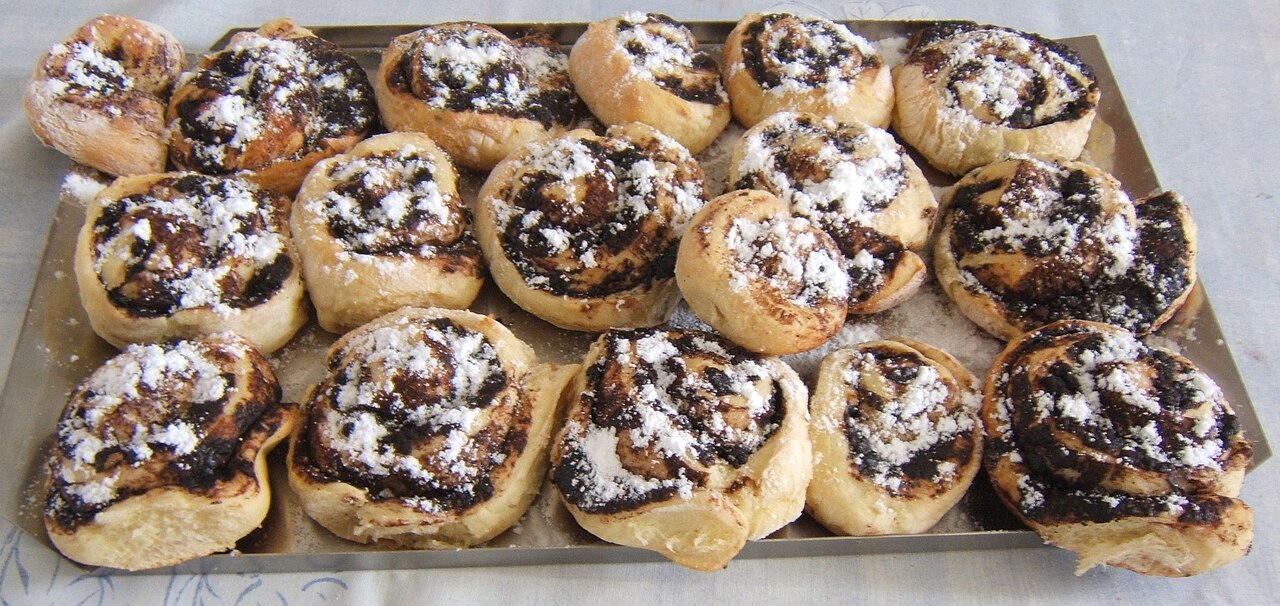
The names of the two other classics are small pictures. Kakaós csiga [ˈkɒkɒoːʃ ˈt͡ʃiɡɒ] means "cocoa snail": dough, usually puff pastry and often yeast dough at home, spread with cocoa and sugar, rolled up and sliced, so each piece looks like a snail's shell. The origin of csiga itself is uncertain; it may go back to an Old Turkic word for "circle".
Túrós táska [ˈtuːroːʃ ˈtaːʃkɒ] means "túró bag". The dough is folded over a sweet filling of túró, Hungary's fresh curd cheese, like a little parcel. Táska, "bag", was borrowed from Italian tasca, "pocket". Túró itself came from a Turkic language.
Next to them on the counter you will usually find pogácsa, the small savoury scone. Our pogácsa article tells its story.
What the bakery counter costs
The Hungarian statistical office (KSH) tracks the national average price of a plain white roll, the zsemle [ˈʒɛmlɛ], of white bread and, perhaps surprisingly, of a kakaós csiga.
- Zsemle (plain white roll): 71 Ft each on average in 2025, up from 31 Ft in 2021.
- Kakaós csiga: 258 Ft each in 2025, up from 155 Ft in 2021.
- White bread: 925 Ft a kilo in 2025, up from 401 Ft in 2021.
The jump came in 2022 and 2023, when the price of a zsemle more than doubled. Since 2023 prices have barely moved: in 2023 a zsemle cost 68 Ft, a kakaós csiga 255 Ft and a kilo of white bread 929 Ft.
These are national averages. A bakery in central Budapest may charge more. KSH does not publish an average for túrós táska.
How to order at a pékség
Rolls and pastries are usually sold by the piece. Point at what you want and say how many: egy [ˈɛɟː] is one, kettő [ˈkɛtːøː] is two.
A few words help at the counter:
- Sós [ˈʃoːʃ]: salty. A sós kifli has salt on top.
- Vajas [ˈvɒjɒʃ]: made with butter. A vajas kifli is richer than the plain one.
- Friss [ˈfriʃː]: fresh. You can ask "Friss?", "Is it fresh?"
Our guide to the weekday lunch menu covers the next meal of a Budapest day.
Sitting down instead
If you would rather sit down than eat on the go, some of our partners serve croissants. Click a name to see the full menu with prices.
- Grumpy Budapest, District VII: a croissant with fruit, or a pistachio croissant.
- Fat Mama, District VII: a giant vanilla croissant with raspberry ragout, among the desserts.
At DinePass partners the discount applies to à la carte food and drinks. The card's 10–30% discount applies to everyone dining with you.
Quick answers
What is a kifli?
A crescent-shaped Hungarian roll made from a plain yeast dough. The name comes from the Bavarian-Austrian Kipfl, and the roll is generally agreed to be the model for the French croissant.
What is kakaós csiga?
A "cocoa snail": puff pastry or yeast dough spread with cocoa and sugar, rolled up and sliced into spirals.
What is túrós táska?
A pastry folded over a sweet filling of túró, Hungarian fresh curd cheese. The name means "túró bag".
Was the kifli invented after the siege of Vienna in 1683?
No. That is a legend. A medieval Viennese verse chronicle already mentions the crescent roll, in a scene set in 1227.
How much does bread cost in Hungary?
In 2025 a plain white roll cost 71 Ft on average across Hungary, a kakaós csiga 258 Ft and a kilo of white bread 925 Ft, according to KSH.
The word origins and pronunciation from Wiktionary; the kifli's history from Wikipedia and Europeana; bread prices from the KSH table of yearly average consumer prices; partner dishes from their live menus. Checked on 8 November 2026.

Got a question? Ask a local
Bálint answers personally, usually within a day.
Your question is not stored on this site: it goes straight to WhatsApp or your e-mail app.
A word of Hungarian
Köszönöm
/ˈkøsønøm/
Was this page useful?