How to read a Budapest menu: köret, feltét, prices per 100 g and the mistakes to skip
On a Budapest menu in November 2026, the main course often comes without its side. The köret, the side dish, is a separate line that typically costs about 1,000 – 2,000 Ft (about €3–5). Steaks may be priced per 100 g, at around 4,300 – 6,500 Ft, and a service charge of up to 15% can follow.
None of this is a trick. It is simply how Hungarian menus are built, and once you can read the layout, the bill holds no surprises.
Below: the order of a Hungarian menu, the words that tell you how a dish is cooked, and the prices that are not per plate. Then what the law says a menu must tell you, and the ordering mistakes visitors make most often.
The order of the menu, from előétel to desszert
A full Hungarian menu, the étlap, usually has sections such as előételek (starters), levesek (soups), főételek (main courses), köretek (sides), saláták (salads) and desszertek (desserts). Drinks often have their own list, the itallap.
The words themselves are small lessons. Étlap is simply étel, food, plus lap, sheet: a food sheet. Előétel, the starter, is a word-for-word copy of the German Vorspeise, and feltét, the topping, copies the German Auflage.
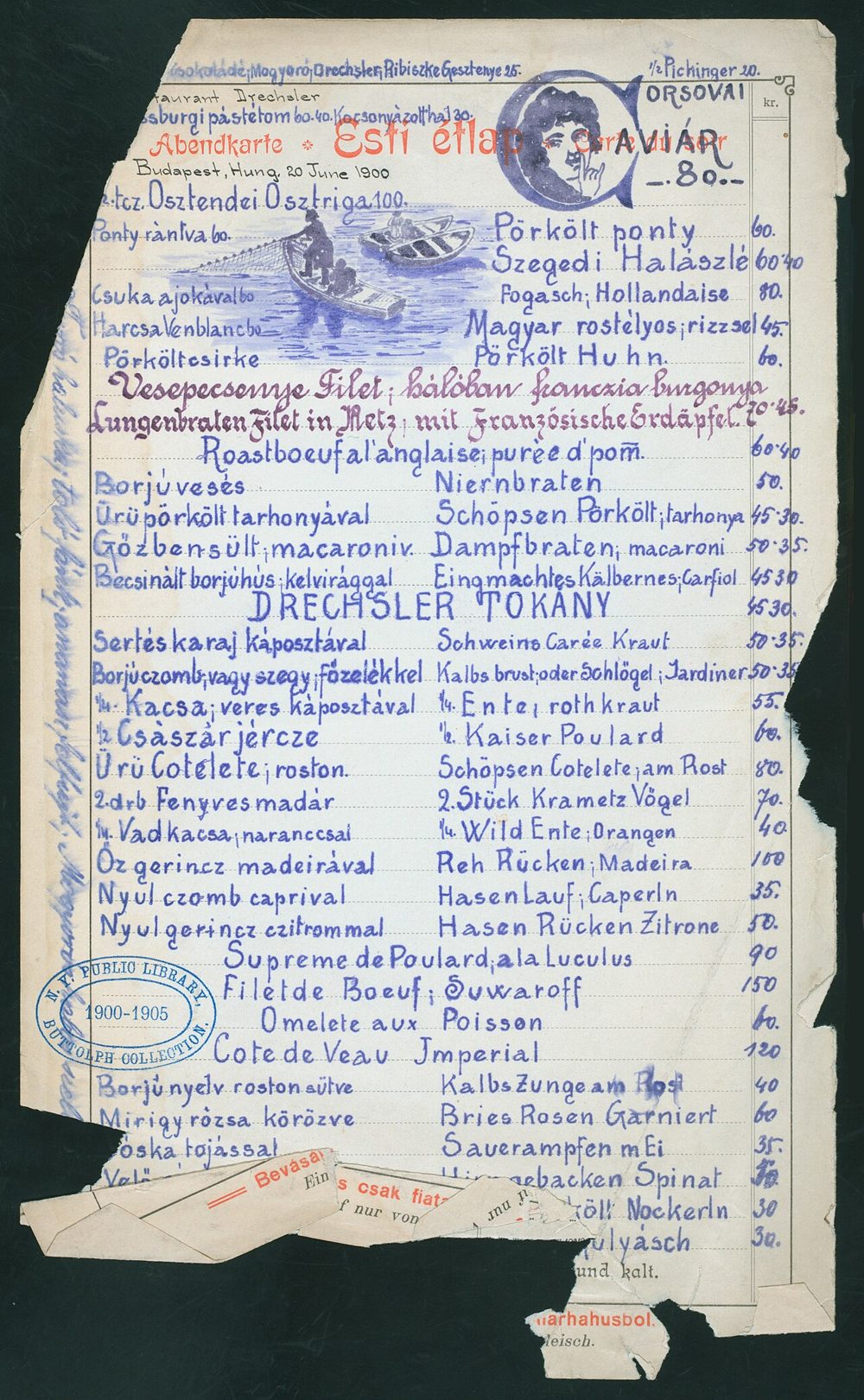
The layout is old, too. A supper menu from Budapest's Restaurant Drechsler, handwritten on 20 June 1900, lists szegedi halászlé, pörkölt and rostélyos rizzsel, braised beef with rice. It is now held by the New York Public Library.
Soups have their own section. Gulyás belongs there, which is why it arrives with a spoon: our goulash guide explains the soup, the stew and the paprikash.
A menü is something else again: a set meal at a fixed price, such as the weekday napi menü. Ordering dish by dish from the étlap is à la carte, from the French for "according to the card".
Köret: why the main course arrives alone
On many Budapest menus, the main course is just the meat or fish, and the side is listed under köretek. The word is built on kör, which means circle.
A side typically costs about 1,000 – 2,000 Ft in November 2026. The range runs from about 750 Ft for a portion of rice to almost 5,000 Ft for a plate of grilled vegetables. The usual choices are hasábburgonya (chips), rizs (rice), burgonyapüré (mashed potato) and grilled vegetables.
There is a useful clue to whether the side is included. Look for the ending -val or -vel, which means "with": csirkepaprikás nokedlivel is chicken paprikash with nokedli, small egg dumplings. It often means the side is on the plate, but if in doubt, ask.
Sauces and extras are often separate lines too, roughly 300 – 1,200 Ft. Bread can be charged, from about 400 Ft and sometimes over 1,000 Ft, so ask before the basket arrives if you do not want it.
Words that tell you how a dish is cooked
A few words in front of the dish name tell you most of what you need. Learn these and half the menu reads itself.
- Rántott: breaded and fried. Rántott sajt, breaded fried cheese, is one of the best-known meat-free mains.
- Sült: roast or fried, as in sült kolbász, fried sausage, or sült csirke, roast chicken.
- Töltött: stuffed. Töltött káposzta is cabbage leaves stuffed with pork and rice, the dish in our stuffed cabbage guide.
- Házi: from ház, house, so on a menu házi marks a homemade dish.
Spice is marked separately. Some menus mark hot dishes with chilli symbols, and the word to look for is csípős, spicy.
Prices per 100 g, per piece and per portion
Most prices are per plate, but not all. Steaks in particular can be priced per 100 g: in November 2026, steaks on Budapest menus are listed at around 4,300 – 6,500 Ft per 100 g (about €12–18).
That adds up quickly. One porterhouse is listed at 4,800 Ft per 100 g, with a minimum weight of 900 g. So the plate costs at least 43,200 Ft (about €118).
Two more words matter. Db, short for darab, means pieces, so "2 db" is two pieces: the 1900 Drechsler menu still wrote "2 drb". Unusually for a Hungarian abbreviation, db takes no full stop.
Adag means a portion. It is a young word: it was coined during the Hungarian language reform and first recorded in 1824.
What the menu must tell you
The service charge has a legal name, felszolgálási díj, and is also called szervizdíj in everyday speech. Under Hungarian rules it must be shown with the prices on the menu, and it normally appears as a separate line on the receipt.
There is also a ceiling. For ordinary guests, the service charge may be at most 15% of the price of what you ate and drank, VAT included. It is not a tip: our tipping guide explains what to add on top, if anything.
Allergens are covered by EU rules, which list 14 of them, from gluten and milk to celery and mustard. Every Hungarian restaurant must post a notice saying where guests can get allergen information. It has to be given before you order, free of charge, by word of mouth or in writing.
The ordering mistakes visitors make most often
Our video "15 Budapest Food Mistakes Tourists Make" covers the most common ones. Here are the eight that start at the table, each with the guide that explains it.
- Ordering gulyás and expecting a thick stew. The stew is pörkölt: see the goulash guide.
- Clinking beer glasses. Traditionally, Hungarians do not: see why Hungarians don't clink beer glasses.
- Asking for a wine spritzer. You order a fröccs by its ratio: see the fröccs guide.
- Tipping before reading the bill. Check for the service charge first: see the tipping guide.
- Assuming a vegetable dish is meat-free. Lecsó, the pepper and tomato stew, often contains sausage: see the vegetarian guide.
- Expecting a vinegar pickle. The summer kovászos uborka is fermented: see the pickles guide.
- Buying bottled water. Budapest tap water is safe: see is tap water safe to drink in Budapest.
- Missing the last question. Egyben vagy külön? means one bill or separate bills: see ten Hungarian words for restaurants.
Ordering à la carte also matters for one discount. The card's 10–30% discount applies to everyone dining with you. The DinePass card covers à la carte food and drinks, not the napi menü or the service charge. The price guide shows what a typical meal costs before any discount.
Quick answers
Why does my main course come without a side dish in Budapest?
On many Budapest menus the side dish, köret, is listed and charged separately. In November 2026 a side typically costs about 1,000 – 2,000 Ft. If the dish name ends in -val or -vel, such as nokedlivel, the side is often included.
What does "100 g" next to a price mean on a Hungarian menu?
The price is per 100 grams, common for steaks. In November 2026 steaks on Budapest menus cost around 4,300 – 6,500 Ft per 100 g, so a 400 g steak costs four times the listed price.
How much can a service charge be in a Hungarian restaurant?
For ordinary guests, the service charge, felszolgálási díj, may be at most 15% of the price of what you ate and drank. It must be shown on the menu and normally appears as a separate line on the receipt.
Do Hungarian restaurants have to tell me about allergens?
Yes. EU rules cover 14 allergens, and every Hungarian restaurant must say where you can get the information. It must be given before you order, free of charge, by word of mouth or in writing.
What does rántott mean on a Hungarian menu?
Rántott means breaded and fried. Rántott sajt, breaded fried cheese, is one of the best-known meat-free main courses in Budapest.
Menu words from Wiktionary; the service charge rules from Hungarian decrees 44/2024 NGM and 4/2009 NFGM–SZMM (Jogtár); allergen rules from the European Commission and Nébih, the Hungarian food safety authority; the 1900 Drechsler menu from the New York Public Library via Wikimedia Commons; side, extra and steak prices from Budapest restaurants' live menus on dinepass.eu. Checked on 17 November 2026.

Got a question? Ask a local
Bálint answers personally, usually within a day.
Your question is not stored on this site: it goes straight to WhatsApp or your e-mail app.
A word of Hungarian
Étlap
/ˈeːtlɒp/
Was this page useful?